Orientation, Rules & What to Expect
The mandatory orientation, the 60 lb weigh-in, campfires, drinking water, bears, and the six emergency radios.
On this page
The Bowron is a managed wilderness. There is an orientation you must attend, a scale your gear has to pass, and a short list of things that will get you evicted. None of it is difficult — but all of it is easier to know before you arrive than to discover in the parking lot.
Day one: orientation is not optional
Every party attends an orientation at the Registration Centre on the morning of their first reserved day. Sessions run from 8 am to 12 pm. Staff go through the route, the rules and the current conditions, and hand you a park map.
Miss it and you are a no-show — your reservation can be released, and the slot given to someone else. If you are driving in that morning, build the drive around being there before noon, not after.
Check in at the Registration Centre again before you start the first portage. Staff track who is out on the circuit, and that record is what makes a search possible if something goes wrong.
The weigh-in
At orientation you weigh your gear on a scale in the parking lot. The limit is 28 kg — 60 lb — of equipment in the canoe while it is on a cart. This is about the trails, not about you: an overloaded boat on a cart tears up the portage.
The practical consequence is that you decide in advance what rides in the canoe and what rides on your back. Everyone in the party needs a pack they can actually carry for two and a half kilometres. Plan for that before you are standing at the scale re-packing on the gravel.
Canoe carts have a rule of their own: the axle can be no wider than 75 cm (30 in). If you bring your own cart and it is wider, it will not be allowed on the trails.
Weigh your gear at home. It is a lot more pleasant to find out you are 5 kg over in your own driveway than in the parking lot with a launch time to make.
Reading the markers
Two colours, and they mean different things. Yellow markers flag campsites along the lakes — they can be surprisingly hard to spot until you are close, so keep the map you were given at orientation to hand and know roughly where the next one should be. Orange markers mark channels into the rivers and marshes. Look for them at the ends of the lakes; they tell you which way the route continues.
Campfires
Fires are allowed when there is no ban in force for the Cariboo fire region. Bans are common in high summer, and they change through the season — check the current restrictions before you count on one.
When fires are allowed: use the fire pit that is already there, never build your own, and take wood only from the woodlots along the circuit — you will be told where they are at registration. Do not collect wood off the forest floor; that is habitat. Only paper goes in the fire, nothing else, and nothing is left in the pit when you go.
What a campsite actually has
Every site has a fire pit, at least one bear cache and a pit toilet. Larger sites have more than one cache. That is the extent of it.
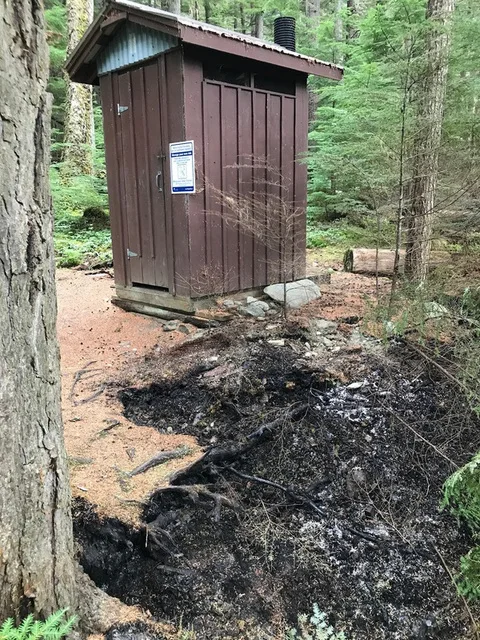
Most sites have no table. Some have a bench or a good large stump; on others you will get creative. Bring toilet paper — the outhouses are not reliably stocked — and expect rustic rather than serviced.
Bears
The park has both black bears and grizzlies. Everything with a scent goes in the cache overnight: food, obviously, but also toiletries, garbage and cooking gear.
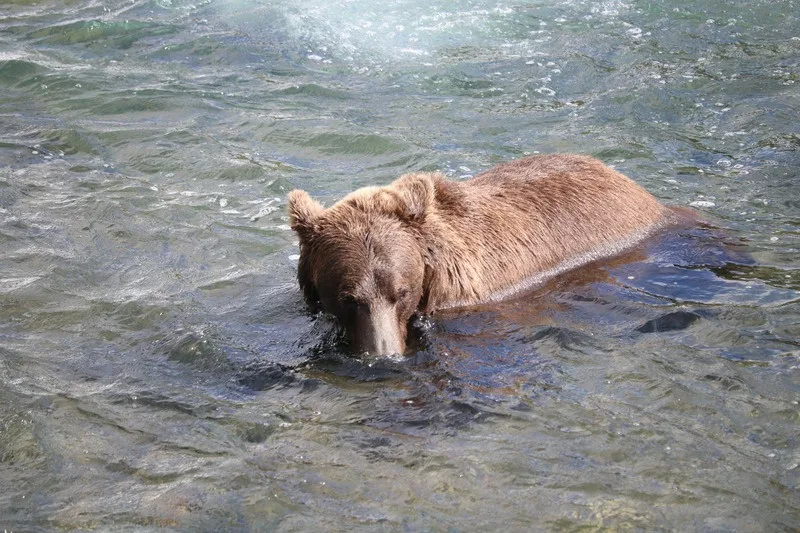
The trick that makes this painless is packing food in small dry sacks from the start, so that at the end of a long day you lift two bags out of your pack and into the cache rather than unpacking everything. Nothing scented ever goes in the tent.
Drinking water
There is no potable water on the circuit. You can draw from any lake or stream — the bigger lakes run clearer — but treat everything: a rolling boil for at least two minutes, a filter, or purification tablets. Fill up at the tap at the Registration Centre before you set out, because there is none on that first portage.
Cook on a stove, not the fire
Bring a camp stove and plan to cook on it. Cooking over a fire leaves smells that draw bears into the site. Bans are frequent enough that a fire is never something to rely on. And the woodlot firewood is finite — if every party cooked on it there would be none left for anyone to sit around.
Pack out what you pack in
There are no bins anywhere on the circuit. Everything you carry in comes back out with you, including anything you find. A couple of large ziplocs make this genuinely easy; a bin bag at the bottom of a pack does not.
No cell service, and six radios
There is no cell coverage anywhere on the circuit. Plan on that being true for the whole trip.
BC Parks keeps emergency radios mounted on the outside of six buildings around the route:
- The ranger cabin at the start of Indianpoint Lake, close to the portage trail
- Wolverine Ranger Cabin, where the two arms of Isaac Lake meet, on the north side
- The ranger cabin at the far end of Isaac Lake, next to the campsite
- Lanezi Lake, beside the covered shelter at the Turner Creek campsite (#33)
- Babcock Creek Ranger Cabin, as you enter Babcock Creek from the Cariboo River
- The ranger cabin at Pat’s Point, between Spectacle and Swan, on the northeast shore
You are welcome to carry your own satellite messenger or beacon. You may not transmit on the frequencies BC Parks uses.
Six radios over 116 km means there are long stretches with nothing. Before each day, note which cabin is ahead of you and which is behind. That is the question that matters if someone is hurt.
Who else is out there
No motorised craft are allowed on any of the lakes or waterways except Bowron Lake itself. You will still see motorboats occasionally — those are staff and rangers, out for visitor safety, campsite and trail maintenance, and enforcement. They may call in at your campsite, which is normal and usually welcome.
What you cannot bring
- No dogs or other pets — not anywhere in the backcountry
- No commercial beverage containers: beer, pop, wine, juice and the rest. Boxed wine with the cardboard removed is fine. This one is strictly enforced by park rangers and carries eviction and a fine
- No firearms or bear bangers
- No chainsaws
- No combustion or electric motors
- No portable speakers
- No drones without a permit
- No smoking or vaping
- No cutting trees or vegetation, and no camping outside designated sites
BC Parks publishes the authoritative version of all of this in their pre-trip booklet, and updates it as rules change.
Check in when you get back
On the day you come off the water, call in at the Registration Centre even if you have no canoe to return and nothing to hand back. Staff close off the record of every party that went out. It takes a minute, and it is how anyone knows you are safe.
Canoes waiting at the start and the finish.
Book a CanoeLive availability on FareHarbor · no shuttling required