Tips for Success: Loading, Bears & Staying Dry
Field-tested advice from the trailhead: trimming your canoe, keeping gear watertight, and staying bear-smart.
On this page
None of this is difficult. It is the accumulated small stuff — how the boat is packed, where the dry bags are, what you do when it rains — that separates a trip people talk about for years from one they endure.
Loading your canoe
Aim for at least 15 cm of freeboard: the distance between the water and the gunwale. Less than that means you have either too much gear or too small a canoe, and both make for a wet, slow, nervous trip.
Pack low and never stack. The heaviest items go in the centre, and you work outwards toward bow and stern from there. Balance it side to side as well as end to end — a boat that lists is tiring in a way you will not notice until hour three. Your cart lies on top of the load with the wheels up.
Put the heaviest paddler in the stern. A canoe heavy in the bow is genuinely hard to steer. If the heavier person has to sit in the bow, shift gear aft until the trim comes back.
Be watertight
Everything that matters goes in something waterproof. Dry bags are ideal and the cheap lightweight ones are fine. A waterproof compression sack for your sleeping bag is the single best purchase for this trip — it guarantees a dry bag and takes up less room than a stuff sack.
Garbage bags make perfectly good pack liners if you would rather not buy dry bags for everything. Whatever you use, your sleeping bag stays dry. In a bad situation that bag is the thing that fixes it.
Keep the basics within reach
Each paddler wants a small dry bag at hand with snacks, water and rain gear in it. The point is that you can get to them without unpacking the boat mid-lake — which is exactly when the weather turns and you need the rain shell.
Portaging with a cart
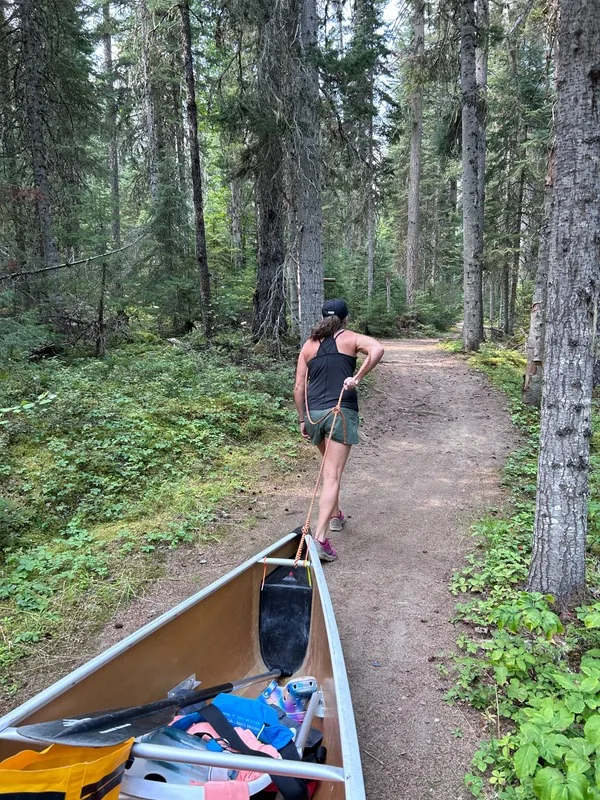
Your trip opens with a 2.5 km portage, so you learn this on day one whether you meant to or not. Assuming two of you to a canoe:
- Take the packs out before you lift the canoe onto the cart. It is heavy enough empty.
- Centre whatever gear stays in the boat over the cart’s axle.
- Set the axle near the middle of the canoe, then adjust. If the stern person is pushing down hard to keep it level, the cart is too far forward.
- The bow person tows, with the bowline over their shoulders. Easy on the flat and downhill, work on the climbs.
- The stern person keeps the boat balanced and, more importantly, keeps it in the centre of the trail.
The ground is uneven and bumpy in places, and a canoe that wanders off the trail catches. Watch it rather than the view. Both jobs are work, and you will both be sweating at the far end — but each portage is easier than the last, and by the third you will have it.
Getting back on the water
Wheel the canoe so the bow or stern is over the water, unstrap the cart, and with one person each side slide it in. Then load your gear with the boat already floating — considerably easier than loading it on land and trying to lift the result.
Practise before you come
Everyone in the party should be able to launch a canoe, hold a straight line and turn both ways before they arrive. It is not a skills course, but a first lesson in the middle of Isaac Lake is a miserable place to have one.
Learn a low brace as well. It is the stroke that stops a capsize, and the fast water of the Cariboo River is where you may want it.
When it rains hard
In order: shelter up first, then dry clothes, then warm food, then a fire if one is allowed. That sequence matters — people get it wrong by trying to make dinner while still soaked.
If fires are banned, do not improvise. Get in the tent, get in the sleeping bag, and be warm and dry there instead. Waiting out a bad afternoon in comfort is a perfectly good use of a day, which is exactly why your plan should have a spare one in it.
Bear safety
Both black bears and grizzlies live here. Rangers have worked hard to keep them from associating people with food, and the whole system depends on every party holding up their end: everything scented in the cache, nothing in the tent, and fish never cleaned at a campsite.
Bears will usually not approach if they know you are there, so make noise on the trails — talk, sing, be obvious. If you meet one near your camp, stay calm and watch what it does. Bears dislike being surprised; if it has not noticed you, make some calm noise and it will most likely move off.
If it seems agitated, keep making noise and walk calmly towards your canoe. Almost always the bear leaves. If you are not comfortable, get on the water and give it the space — that option is the advantage of travelling by canoe.
Camping ethics
- Use the bear cache for anything scented, whenever you are away from camp or asleep.
- Wash water goes down the pit toilet, never into the lake.
- No soap and no food scraps in the water.
- Do not clean fish at your campsite.
- Everything you packed in is packed out, including anything you find.
- A fire only if there is no ban, and only in an existing pit.
- All drinking water treated or boiled.
Bring an extra day of food
Two, if you have room. Wind and rain will slow you more than you expect, and a party that has to keep paddling because the food ran out is a party making decisions for the wrong reason.
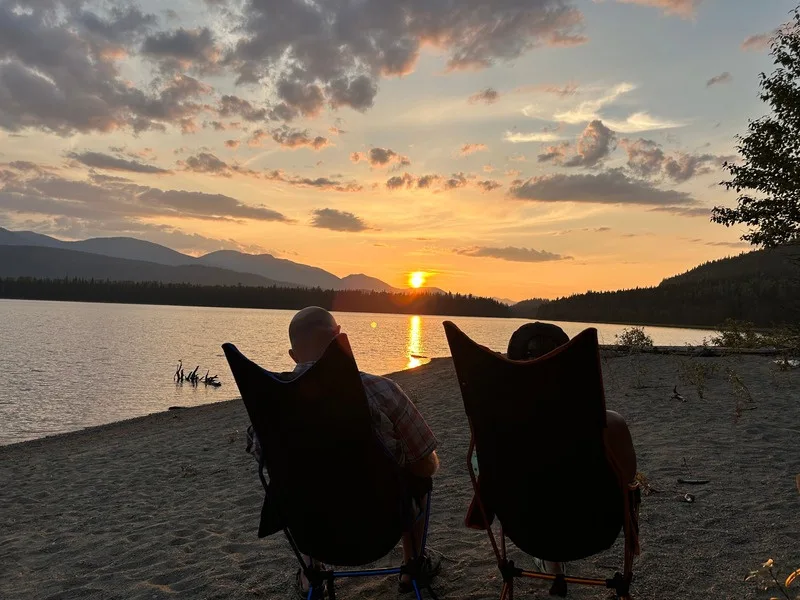
If you have packed genuinely light, bring a compact camp chair. After eight hours in a canoe, sitting down properly on a beach with a back rest is worth more than almost anything else of the same weight.
One rule people forget
No glass, and no commercially packaged beverage containers of any kind — beer, pop, juice boxes, all of it. Boxed wine is fine once the cardboard is off. This is enforced, and the consequence is eviction and a fine, so deal with it at home rather than in the parking lot. The full list is in what to expect.
Canoes waiting at the start and the finish.
Book a CanoeLive availability on FareHarbor · no shuttling required